Reportings
How to genereate reports
Reporting
This documentation provides an overview of the financial dashboard, operational journals, and regulatory reporting capabilities within the accounting module.
1. Executive Financial Dashboard
The primary dashboard offers a real-time summary of organizational financial health in Kip (₭).
Key Performance Indicators (KPIs)
Metric Fiscal Year To Date Current Month
Net Profit or
Loss 3,629,199,656.00 ₭ 0.00 ₭
Total Income 5,014,491,371.00 ₭ 0.00 ₭
Total Expenses 1,385,291,715.00 ₭ 0.00 ₭
Unreconciled
Items 0 Item(s) 0 Item(s)
Visual Analytics
- Income/Expense Chart: Provides a comparative view of Income, Expense, and Profit/Loss over the selected fiscal period.
- Invoices Summary: Tracks "Total Paid" versus "Total Invoice" for the current month.
- Bank and Cash Balances: Displays liquid asset status for specific accounts (e.g., วิละພອນ: 113,964.00 ₭).
2. Accounting Operations Menu
The Accounting dropdown menu contains core administrative tools for ledger management and transactional control.
- Journals: Access categorized logs for Sales, Purchases, Bank and Cash, and Miscellaneous entries.
- Ledgers: Includes the General Ledger (GL) and Partner Ledger for detailed financial tracking.
- Management: Tools for overseeing organization Budgets and fixed Assets.
- Actions: Contains the Lock Dates feature to prevent unauthorized changes to closed fiscal periods.
3. Reporting and Compliance
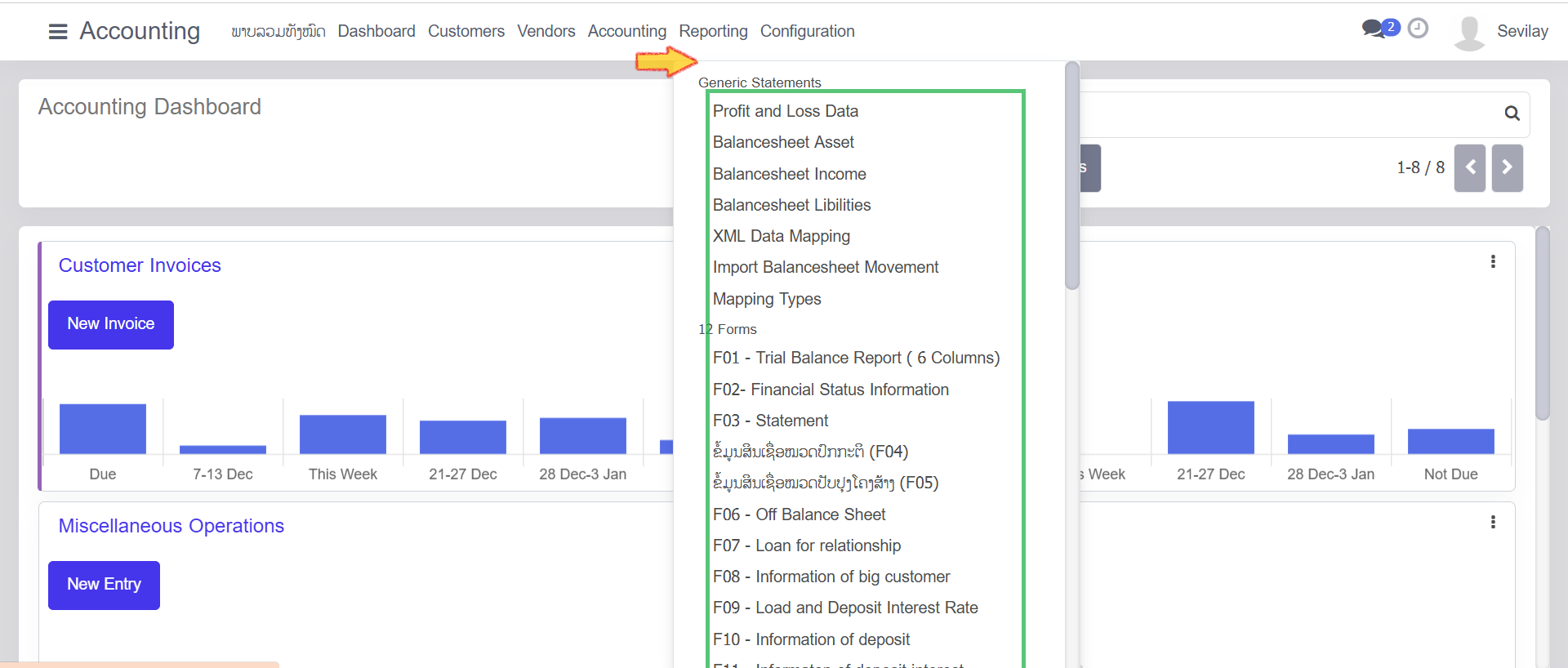
The Reporting menu facilitates the generation of both standard financial statements and specialized regulatory forms.
Generic Statements
- Profit and Loss Data: Summarizes revenues and expenses.
- Balance Sheet Data: Detailed reports for Assets, Income, and Liabilities.
- Data Tools: Includes XML Data Mapping and Import Balancesheet Movement for external data integration.
Regulatory Compliance (12 Forms)
The system supports standardized reporting templates, including:
- F01: Trial Balance Report (6 Columns).
- F02: Financial Status Information.
- F03: Financial Statement.
- F06: Off-Balance Sheet items.
- F08 – F10: Specialized reports for Big Customers, Interest Rates, and Deposits.
4. Operational Shortcuts
The Accounting Dashboard provides direct access to high-frequency tasks:
- Customer Invoices: Create a New Invoice.
- Vendor Bills: Upload documents or create bills manually.
- Bank Accounts: Connect to banking services or manually create statements.
- Miscellaneous Operations: Record a New Entry for non-standard transactions.
F01-Trial Balance
1. Interface Overview
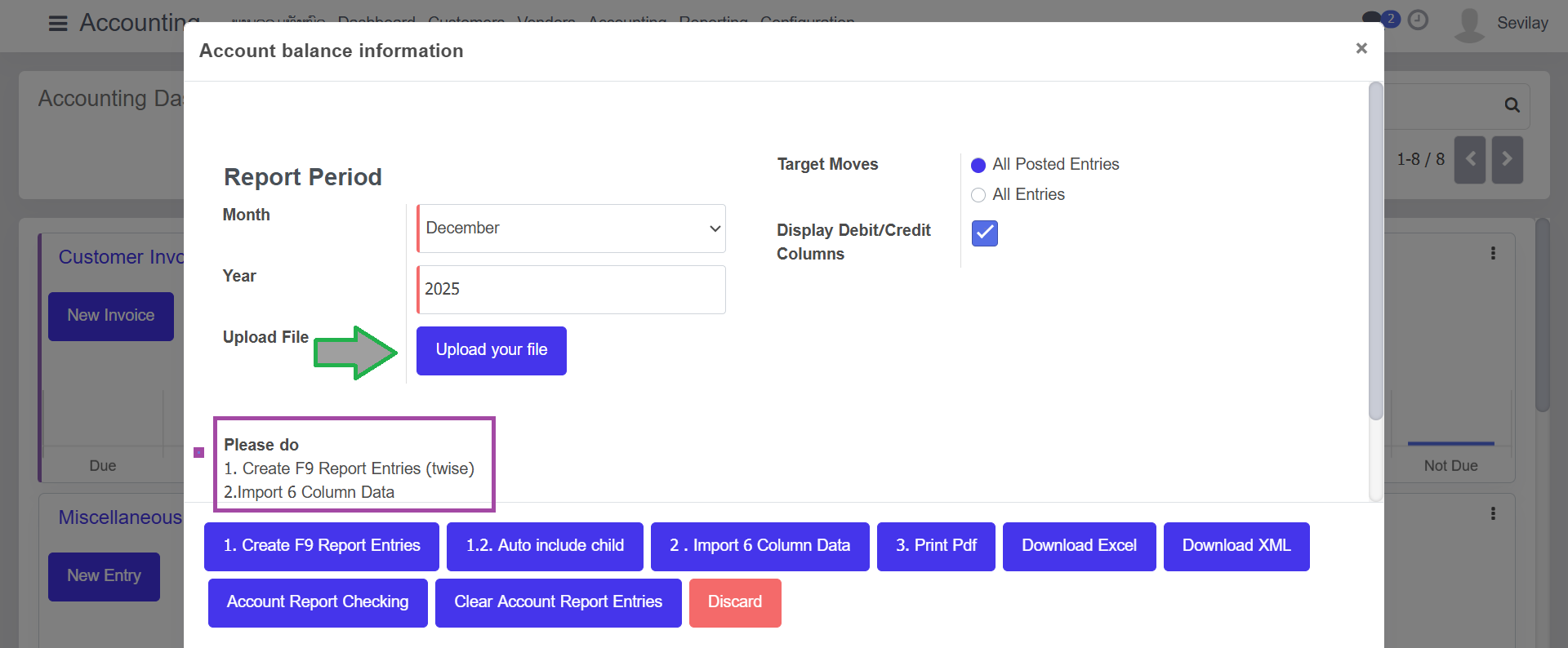
The Account Balance Information pop-up allows administrators to define the scope of a financial report and perform data-processing actions.
A. Report Period Configuration
- Month: Select the specific month for the report (current selection: December).
- Year: Specify the fiscal year (current selection: 2025).
- Upload File: Use the "Upload your file" button to provide source documents for processing.
B. Report Parameters
- Target Moves: * All Posted Entries: Includes only finalized/validated accounting entries.
- All Entries: Includes drafts and unposted entries.
- Display Debit/Credit Columns: When checked, the system will split financial movements into separate debit and credit columns.
2. Standard Operating Procedures (SOP)
Phase 1: Generating Report Entries
- Verify that the Month and Year are correct.
- Select the desired Target Moves filter.
- Click 1. Create F9 Report Entries.
- Note: If hierarchical data is required, click 1.2. Auto includes a child.
- According to the "Please do" instructions in the UI, this step should be performed twice to ensure data consistency.
Phase 2: Data Import
- Click the Upload your file button to select your source file.
- Click 2. Import 6 Column Data to map and ingest the data into the current report period.
Phase 3: Validation & Export
- Click Account Report Checking to run a system audit for discrepancies or unbalanced entries.
- Once validated, choose an output format:
- 3. Print Pdf: For formal documentation.
- Download Excel: For manual analysis.
- Download XML: For system-to-system data transfers.
3. Maintenance Actions
- Clear Account Report Entries: Use this button to wipe the current working data and start a new report session.
- Discard: Close the window without saving changes or processing further data.
Warning: Clearing report entries is a permanent action. Ensure all necessary files have been downloaded before clearing.
F02-Financial status information
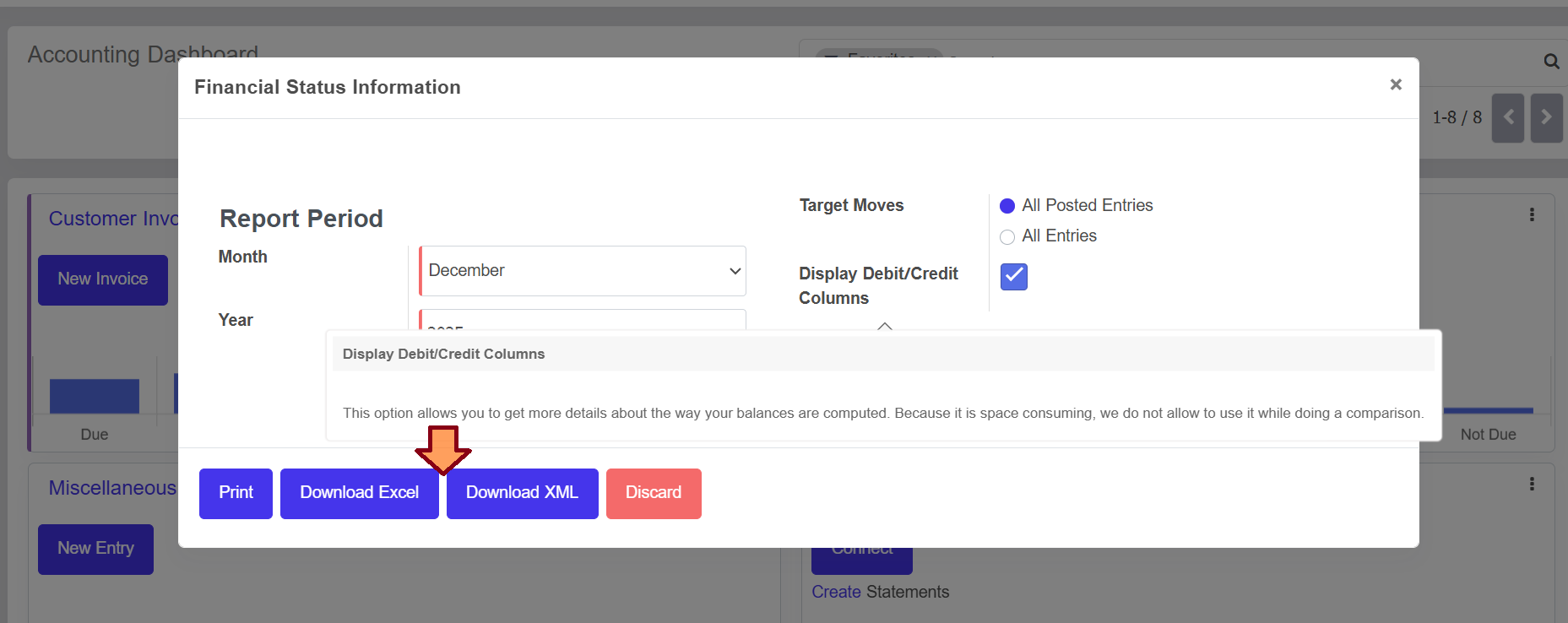
This module allows users to configure and export detailed financial reports based on specific timeframes and accounting criteria. It provides a flexible way to review the company's financial health via printed reports or data exports.
1. Report Period Configuration
The user must define the specific timeframe for the data they wish to analyze.
- Month: A dropdown selection to choose the specific month of the financial year (e.g., December).
- Year: A numeric input or selection to define the fiscal year (e.g., 2025).
2. Target Moves
This section filters which accounting entries are included in the final report:
- All Posted Entries: Only includes finalized, validated journal entries.
- All Entries: Includes both posted entries and draft/unposted entries for a more comprehensive (though preliminary) view.
3. Display Options
- Display Debit/Credit Columns: A checkbox that, when enabled, adds granular detail showing separate columns for debits and credits.
- Note: This provides more detail on how balances are computed. However, this option is disabled when performing report comparisons to save space and maintain readability.
4. Available Actions
The footer of the modal provides several ways to process the requested data:
Action Description
Print Generates a standard PDF or printer-friendly version of the financial status.
Download Excel Exports the data into an .xlsx format, ideal for manual calculation and manipulation.
Download XML Exports the data in a structured .xml format for integration with other systems.
Discard Closes the window without generating a report or saving changes.
F03-Statement
Operational Data Documentation
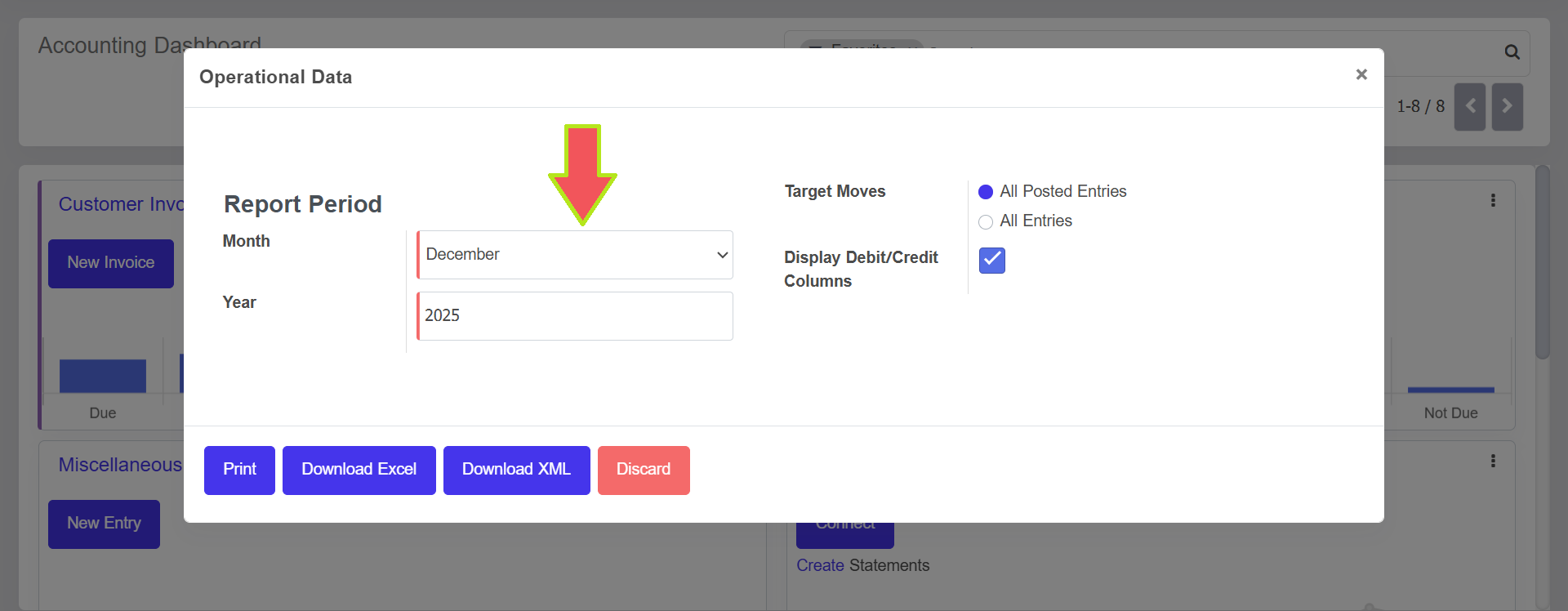
The Operational Data modal provides a specialized interface for configuring and exporting operational reports based on defined timeframes and entry types.
1. Header Information
- Title: Operational Data.
- Close Action: A close icon (x) is located in the top-right corner to exit the modal.
2. Report Configuration Parameters
The user must specify the following criteria to filter the operational data:
A. Report Period
- Month: A dropdown menu used to select the specific month for the report, such as "December".
- Year: A text input field to specify the fiscal year, such as "2025".
B. Target Moves
Users can choose which types of accounting moves to include:
- All Posted Entries: Includes only journal entries that have been finalized and posted.
- All Entries: Includes all journal entries, regardless of whether they are in draft or posted status.
C. Display Preferences
- Display Debit/Credit Columns: A checkbox that allows the user to include or exclude specific columns for debit and credit amounts in the generated report.
3. Action Buttons
The footer contains primary actions for processing the data request:
Button Function
Print Sends the configured report directly to a printer or generates a printable PDF.
Download Excel Exports the operational data into an Excel spreadsheet format for further analysis.
Download XML Exports the data in XML format for system integration or data portability.
Discard Cancels the current configuration and closes the modal without saving or exporting.
F04-Standard credit information
The Standard Credit Information modal is a configuration tool within the accounting dashboard designed to filter and export credit-related data for specific reporting periods.
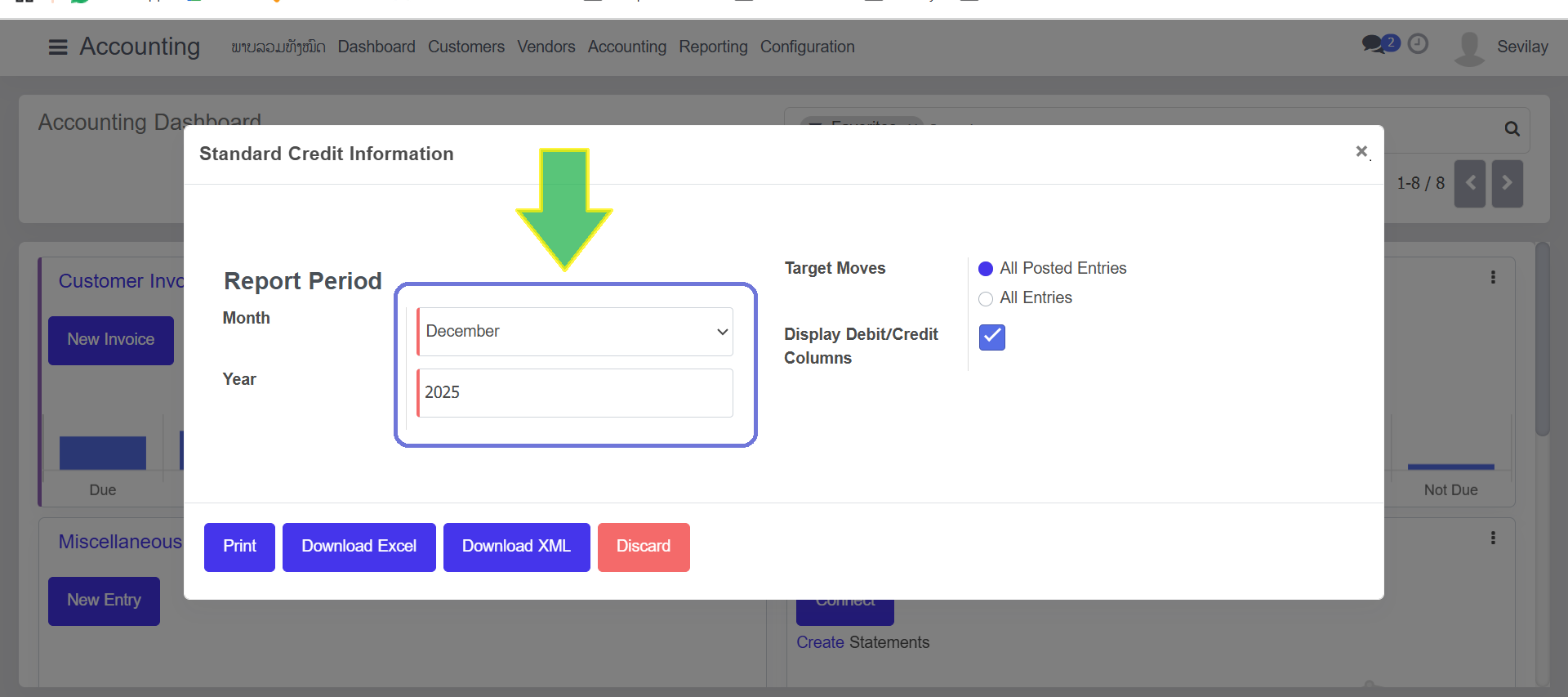
1. Header Information
- Title: Standard Credit Information.
- Close Action: Users can exit the configuration by clicking the X icon in the top-right corner.
2. Configuration Parameters
To generate the report, the user must define the following criteria:
A. Report Period
This section determines the timeframe for the data extraction:
- Month: A dropdown selector used to choose the specific month (e.g., December).
- Year: A text entry field to define the fiscal year (e.g., 2025).
B. Target Moves
Users can filter the accounting records based on their status:
- All Posted Entries: Filters the report to include only finalized and validated journal entries.
- All Entries: Includes all records, including draft and unposted entries.
C. Display Preferences
- Display Debit/Credit Columns: A checkbox that, when toggled on, includes detailed debit and credit columns in the output rather than just the net balance.
3. Action Buttons
The footer provides multiple processing and export options for the configured data:
Action Result
Print Generates a printer-friendly version of the credit information report.
Download Excel Exports the data into an .xlsx format for spreadsheet analysis.
Download XML Exports the data in a structured XML format for system portability.
Discard Closes the modal and cancels all unsaved changes.
F05-Restructured Category Credit Information
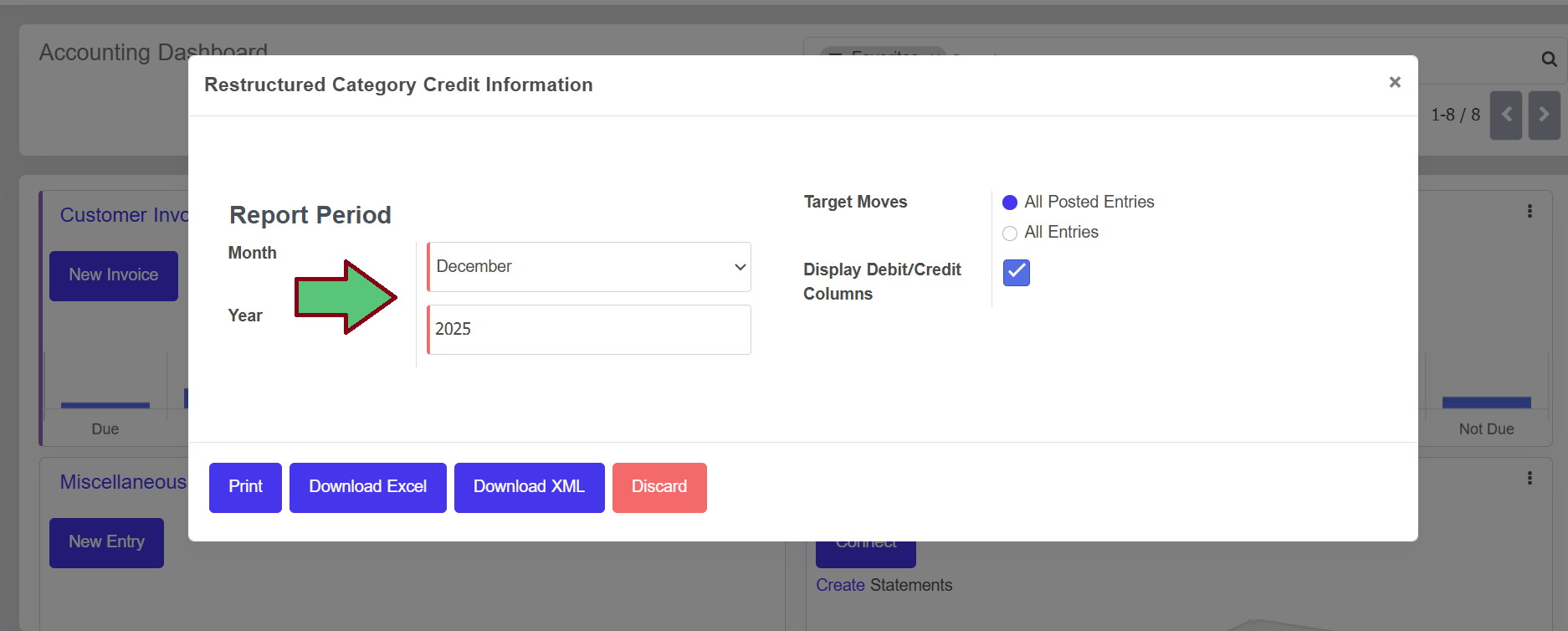
Restructured Category Credit Information Report
Based on the interface provided, this report serves as a specialized financial export tool within the accounting module to generate credit information summaries for specific reporting periods.
Overview
The Restructured Category Credit Information tool allows users to extract credit data, likely for regulatory compliance or internal audit purposes. It provides options for specific time-filtering and data-depth selection.
Configuration Options
- Report Period: * Month: Select the specific month for the data pull from the dropdown menu (e.g., December).
- Year: Define the fiscal year for the report (e.g., 2025).
- Target Moves:
- All Posted Entries: Filters the report to include only finalized and validated journal entries.
- All Entries: Includes both posted and draft/unposted entries in the report.
- Display Debit/Credit Columns: A checkbox that, when enabled, separates financial data into distinct debit and credit columns for more detailed ledger analysis.
Action Commands
Action Result
Print Generates a standard PDF version of the credit information.
Download Excel Exports the data into a .xlsx format for manual analysis or pivot table creation.
Download XML Generates a machine-readable file, typically used for uploading to regulatory portals or external audit software.
Discard Closes the window without generating a report or saving changes.